Gross-to-Net Strategic Enablement: Giving Finance a Seat at the Table
Gross-to-net (GTN) has historically been finance’s responsibility to close and control. Today, biopharma finance leaders are being asked for something more: to walk into the room with commercial and market access stakeholders and help shape pricing, contracting, and net revenue strategy before the numbers land. That shift is only possible with real-time insight into GTN performance, disciplined monitoring of claims against budget, and a clear, forward-looking view of the risks and opportunities ahead. Here’s how the right analytical reporting and data foundation is turning finance from scorekeeper into strategic partner.
Real-Time Visibility: Seeing Net Revenue as It Happens
For years, GTN reporting has meant waiting for the books to close before anyone could see the full picture. That lag is no longer good enough. Finance leaders now need an up-to-date view of budget-to-actuals, with go-forward forecasts layered in, so they can see the full year’s trajectory in net sales at any point in the quarter, not just after close. A live GTN trend analysis view makes that possible: key GTN metrics all in one KPI strip, sitting above a month-by-month rate trend that rolls from actuals straight into close accrual with no visual seam. Finance can see exactly where the line is today, where it is headed, and exactly which month the actuals give way to accrual without waiting on a close cycle.
Proactive Monitoring: Keeping Claims in Lockstep with Budget
Real-time visibility only pays off if it comes with the discipline to act on it. That is where quarter-over-quarter rate bridges and variance explanations earn their keep.
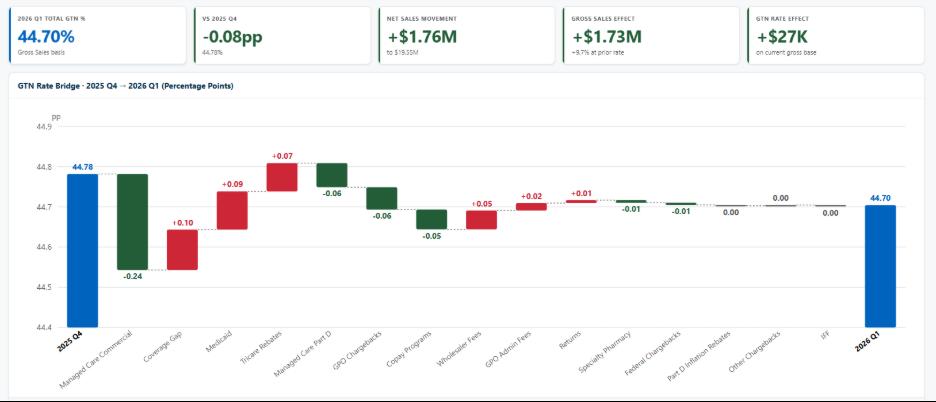
When two segments start moving in lockstep in a way that looks more like duplicate activity than coincidence, that pattern shows up early enough to investigate, not after it has already distorted the quarter.
Risk & Opportunity Schedules That Power the Decision
Monitoring the present is only half the job; finance also has to quantify what is coming. A live risk and opportunity schedule that ranks every deduction category and forecast variance by its dollar impact to net revenue turns scattered watch-outs into a single, prioritized view. For example, managed care commercial as the largest deduction at 14.04% of gross sales, GPO chargebacks tracking favorably to forecast by $236K, gross sales volume and price running $2.24M unfavorable. That structure gives finance a clear starting point for a planning conversation, backed by the number that matters most rather than a wall of line items.
Zoomed out to the full year, that same discipline becomes a quarter-by-quarter schedule spanning every GTN segment; each cell quantified in dollars, flagged as an opportunity, a watch item, or a risk, and rolled up into a single net full-year impact with a confidence level attached:
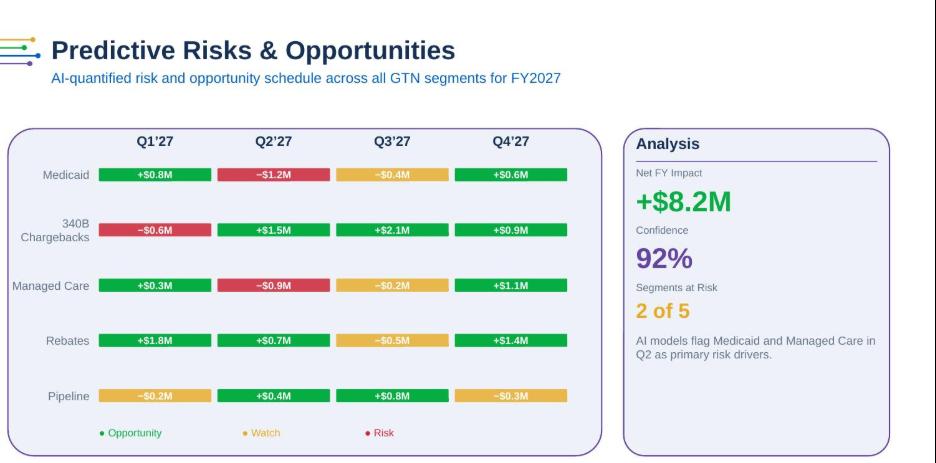
Figure 2 - Example Risk & Opportunity Schedule: Full-Year Exposure & Upside by Segment & Quarter with Net Impact & Confidence
Earning a Seat at the Table: Finance Driving Market Access Strategy
Put real-time insight, proactive monitoring, and a living risk and opportunity schedule together, and finance stops reporting on decisions other people made and starts shaping them. That means challenging pricing and contracting assumptions before they are locked in, weighing the magnitude and timing of a WAC action against its full-year net revenue impact, and coming to conversations with shareholders armed with a clear narrative on QoQ and YoY trends. This is what strategic enablement looks like in practice. Finance becomes an equal partner in market access strategy, not just the function that confirms the numbers after the fact.
About IntegriChain
IntegriChain delivers biopharma’s only comprehensive data-driven commercialization platform from strategy to operational execution, connecting the commercial, financial, and operational dimensions of drug access and profitability. Our ICyte® Platform integrates technology, data, consulting, and managed services to unify critical workflows, replacing manual processes with integrated analytics and precision controls.
Biopharma relies on IntegriChain to optimize patient access and net revenue performance, reduce leakage, and strengthen compliance, ensuring every life-changing therapy reaches patients with speed, affordability, and sustainability. Backed by Nordic Capital, a leading sector-specialized private equity investor with a broad portfolio in healthcare and technology.
IntegriChain is headquartered in Philadelphia, PA, with a location in Pune, India.